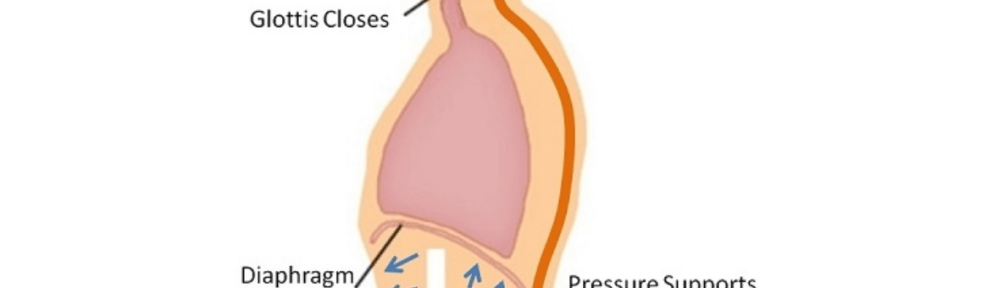
My understanding of how the body works came from spending lots of time at seminars, reading a lot of books and learning from experts in the fields of rehabilitation and performance. All of my mentors, however, have been rehabilitation specialists, so I think about the body from a rehabilitation perspective. That’s how it all makes sense to me; everyone has something “wrong” with their body and as a coach, I want to know what it is so I can create a program that addresses it and at the same time, improve strength and conditioning. There’s always more to learn but if I had to write down the way I see the body in one paragraph it would be this:
“The core stabilizes the pelvis, spine and ribcage using 360 degrees of intra-abdominal pressure (IAP). Loss of intra-abdominal pressure results in poor core stability. Poor core stability leads to the ball and socket joints becoming overly tight to compensate for that lack of stability, which leads to a dysfunction at the big joints of the body, such as the shoulder and hip (usually presenting as a lack of mobility) which leads to dysfunction in the distal extremities (knees, elbows, ankles, wrists).”
From a training perspective, both intra-abdominal pressure and tight, dysfunctional joints need to be handled simultaneously. Trainers can use strength training as a means of improving IAP or mobility in joints by focusing on certain qualities while coaching.
For instance, let’s use Caroline as an example. She sets up for a squat in lower back extension and instead of taking her to the ground and showing her the dead bug, I coach her into the correct position, which helps her develop the IAP she needs by doing a strength training exercise.
Trainers can also use stretches to improve mobility of stiff joints.
In his books, Pavel talks about mobilizing stuck joints by using contract-relax stretching and fast and loose techniques to relax the distal joints. He also discusses using kettlebell, barbell, bodyweight strength training and power breathing techniques to improve intra-abdominal pressure and add strength.
Similarly, Gymnasticbodies by Christopher Sommer uses stretches and mobilizations to release, as well as strengthen, the joints in all angles. The intra-abdominal pressure and strength comes from lots of hollow-body drills, core training, and bodyweight and traditional strength training.
I use all of the above, as well as, classic physical therapy mobilizations, mobility drills inspired by Brazilian Jiu-Jitsu, track and field, etc., to free the distal joints. Intra-abdominal pressure training is as eclectic as the mobilizations, DNS, PRI, McGill, powerlifting and more.
It’s not about “fixing” people, it’s about having assessments to guide our training. Strength and conditioning is much easier when you can coach your athletes based on their needs and not based on what is on the agenda.
 willnassif.com